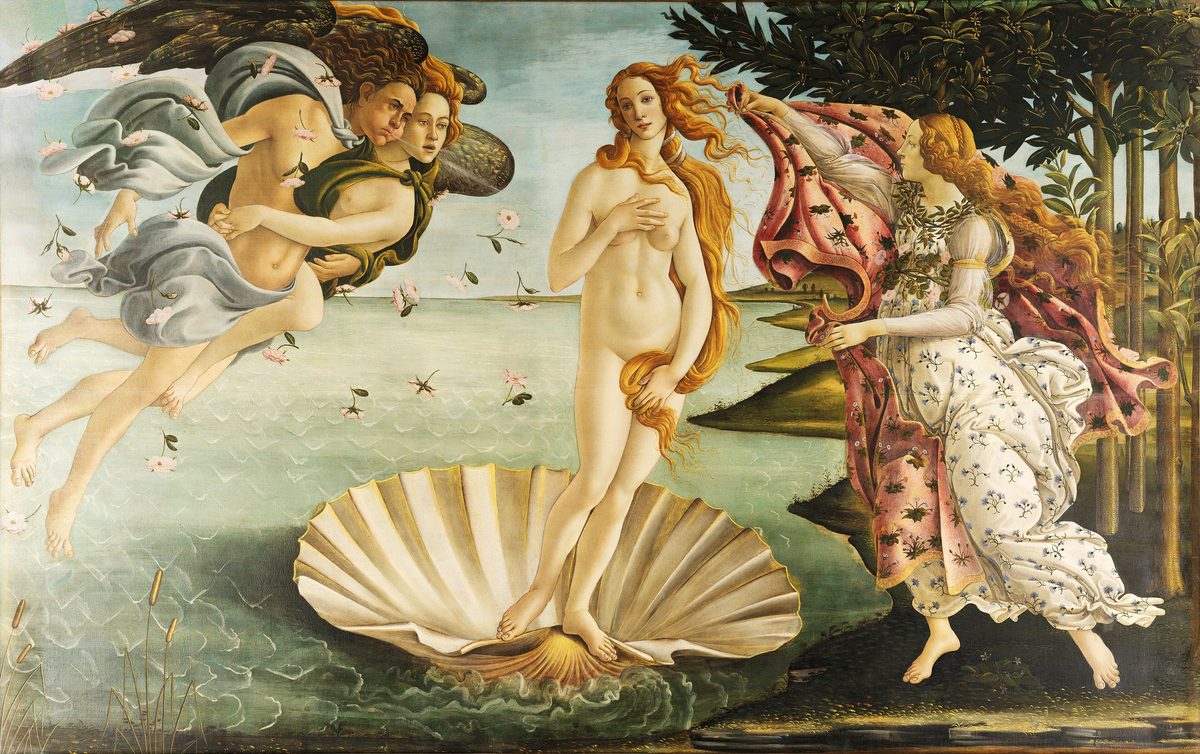
Sandro Botticelli, who painted The Birth of Venus in the mid-1480s, made this large tempera on canvas as an independent mythological scene rather than a religious altarpiece for a church. The picture measures 172.5 x 278.5 cm, a wide horizontal format of roughly 8 to 5, in which pale flesh, sea green, and gold highlights dominate. It now hangs in the Uffizi Gallery in Florence, where the scene shows Venus arriving on a scallop shell, blown toward the shore by two winged wind figures.
What The Birth of Venus shows
At the centre, Venus stands on the edge of a large open scallop shell floating on the sea, her weight on her left leg. She covers her breast with her right hand and holds a long strand of red-gold hair over her lap with her left hand; her head tilts slightly. On the left, two winged figures fly in an embrace and blow towards her. Blue-grey drapery flutters around them, and pink roses float through the air. On the right, a young woman in a white dress with a blue cornflower pattern and a green garland steps from the shore. She holds out a pink cloak with a floral pattern towards Venus. The sea is pale green-blue with small V-shaped waves, and reeds stand at the lower left. A grove of slim trees with dark green leaves and gold-touched trunks rises on the right, with headlands receding behind. The sky is pale and light, and the surface has clear outlines and smooth paint in pale flesh, sea green, and pink with gold highlights.
When and why it was painted
Sandro Botticelli was born in 1445 and died in 1510, so The Birth of Venus belongs to the central part of his working life. He was about forty when he painted it, in the mid-1480s. The painting belongs to his early maturity, when he produced large mythological subjects alongside religious panels for Florentine patrons. As a painter of the Early Renaissance and the Florentine School, Botticelli gave the classical subject a smooth surface and clear outlines. The work was made in tempera on canvas, and at 172.5 x 278.5 cm it is close to life-size for the standing figure. Its later prominence at the Uffizi Gallery in Florence has made it one of the most reproduced images of the Florentine Renaissance.
Seeing it at home
In a hand-painted copy of The Birth of Venus, check the size against the original 172.5 x 278.5 cm; a smaller copy should keep the wide 8 to 5 proportion. Look for the smooth tempera-like surface with clear outlines rather than heavy brush texture. The palette should stay pale and light: flesh, sea green, pink, and gold highlights, with no bright modern blue or orange.