Claude Monet Paintings
Claude Monet paintings record light, weather, and water with a directness that changed French art. Born in Paris in 1840 and based for much of his career in Argenteuil and Giverny, Monet became the central figure of Impressionism. The movement took its name from his 1872 oil on canvas Impression, Sunrise, now in the Musée Marmottan Monet in Paris. His work matters today because he built each canvas from small, visible strokes of color rather than blended studio finish. Museums in Paris, New York, and Washington, D.C. hold Monet paintings, and the water lily subjects made after 1899 still connect plein-air observation to a larger, abstract sense of space. He returned to the same motif under changing daylight and let color do the structural work.
Life and training
Claude Monet was born in Paris on November 14, 1840, but his family moved to Le Havre when he was five. He first became known locally for charcoal caricatures. The painter Eugène Boudin encouraged him to work outdoors with oil paint, and Monet later credited Boudin with opening his eyes to light and weather. In 1859 Monet moved to Paris and enrolled at the Académie Suisse, where he met Camille Pissarro. After military service in Algeria from 1861 to 1862, he returned to Paris in 1862 and entered the studio of Charles Gleyre. There he worked alongside Pierre-Auguste Renoir, Alfred Sisley, and Frédéric Bazille.
Monet's early years in Paris and Argenteuil were financially difficult. He painted with broken color and often worked directly from the motif, qualities that set him apart from Salon painters. During the Franco-Prussian War he lived in London in 1870 and 1871, where he saw works by J.M.W. Turner and John Constable. After returning to France he settled in Argenteuil, a town on the Seine northwest of Paris, and painted modern life along the river. In 1874 Monet showed Impression, Sunrise in an independent exhibition in Paris. A critic used the title to label the group Impressionists, and the name stuck. The 1872 canvas entered the collection of the Musée Marmottan Monet, where it remains.
In 1883 Monet moved to Giverny, a village northwest of Paris where the Epte meets the Seine. He rented the house and later bought it in 1890. At Giverny he created a flower garden and a water garden with a Japanese bridge, which became the setting for many Monet paintings after 1899. From the 1890s he worked in series, returning to the same subject under different light: haystacks, poplars, Rouen Cathedral, and the water lilies. His eyesight declined from cataracts in his later years, but he continued to paint large water lily panels. Monet died at Giverny on December 5, 1926, at the age of 86.
Style and technique
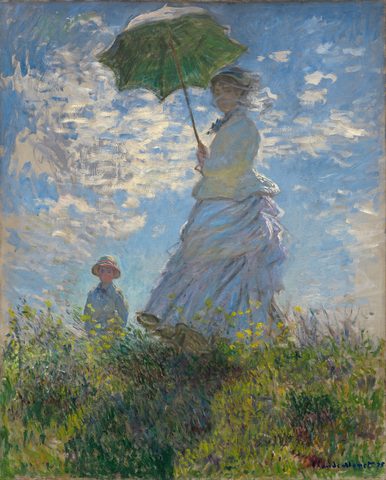
Monet built his canvases with short, separated strokes of oil paint. He often placed pure color next to another pure color instead of mixing them smoothly on the palette. In his landscapes the blues of water and sky sit close to orange, pink, and yellow for sunlight. The 1875 portrait Woman with a Parasol, Madame Monet and Her Son shows this in the clouds and the grass: quick strokes of white, blue, green, and shadow. Monet usually worked outdoors, directly in front of the motif, and painted wet into wet so that edges stay soft. He chose subjects that changed with daylight, such as river views, fields, gardens, and the façade of Rouen Cathedral.
The structure of a Monet painting depends on color temperature and reflected light more than on hard outline. Figures are summarized, water becomes a sheet of moving color, and shadows are rarely black. His early seascapes and scenes of Le Havre owe something to Eugène Boudin, and his time in London in 1870 and 1871 exposed him to Turner's dissolving forms and Constable's cloud studies. Japanese woodblock prints also shaped his flattening of space and high horizon in later garden views. After 1883 at Giverny his brushwork became bolder and his compositions more spacious, especially in the large water lily panels. Late Monet paintings often lose the horizon line entirely and let floating lily pads and reflections fill the whole surface.
What changed over time is the balance between observation and decoration. In the 1860s and 1870s Monet recorded boats, trains, and city streets with a brisk, reportorial touch. By the 1890s he repeated the same motif at different hours, as in the haystack and poplar series. From about 1914 to 1926 the water lily canvases became large, almost wall-sized works in which the surface of the pond works as a field of color rather than a literal place.
Key Monet paintings
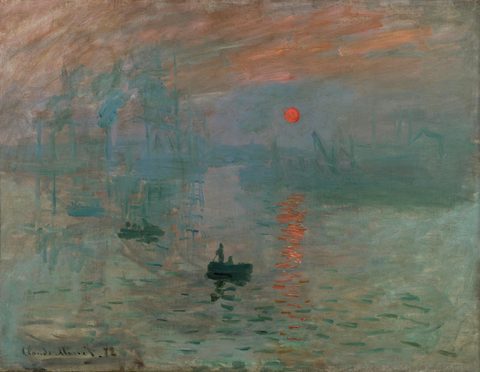
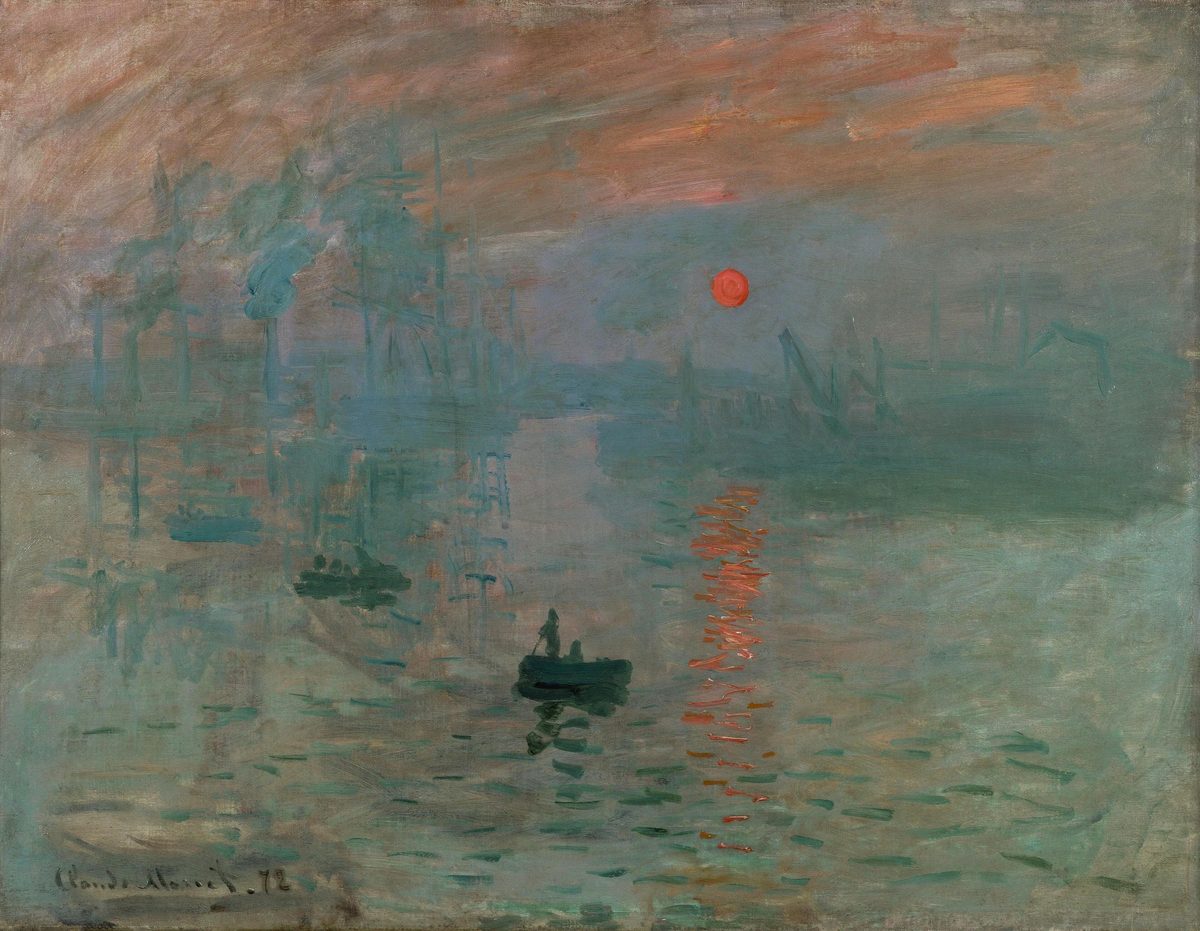
Impression, Sunrise (1872) shows the port of Le Havre at dawn. A small orange sun hangs over gray-blue water, with two rowboats and distant cranes reduced to dark vertical marks. The canvas, 48 by 63 cm, is oil on canvas and belongs to the Musée Marmottan Monet in Paris. Its loose, almost sketchlike handling gave the Impressionist group its name at the 1874 exhibition.
Woman with a Parasol, Madame Monet and Her Son (1875) depicts Camille Monet and their son Jean on a windy hill. The woman stands in a pale blue dress, holding a parasol, while the boy appears smaller in the grass behind her. The painting is 100 by 82 cm and is now in the National Gallery of Art in Washington, D.C. Monet uses strong sunlight and a low viewpoint to make the figure feel momentary, as if a gust of wind will pass.
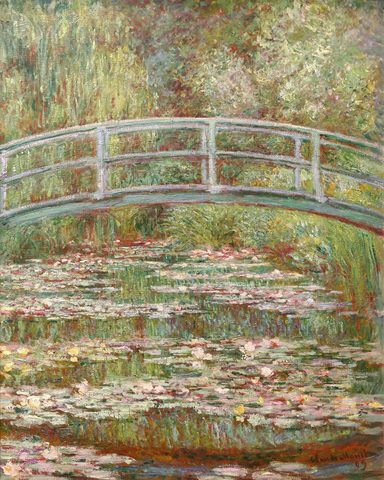
Bridge over a Pond of Water Lilies (1899) shows the Japanese footbridge at Giverny arching over the water garden. The bridge is painted in blue-green with a lighter railing, while water lilies float in pink and white clusters below. The work is 92.7 by 73.7 cm and is in the Metropolitan Museum of Art in New York City. Monet repeated this view many times between 1899 and 1900. Here the bridge spans the top of the canvas and the pond becomes a screen of color, a step toward the large Monet paintings of his last years. These are not the only famous Monet paintings; the haystack and Rouen Cathedral series from the 1890s repeat similar color questions.
Where to see the originals
Many museums hold paintings by Monet, but three originals from this guide sit in major public collections. The Musée Marmottan Monet in Paris owns Impression, Sunrise. The National Gallery of Art in Washington, D.C. owns Woman with a Parasol, Madame Monet and Her Son, and the Metropolitan Museum of Art in New York City owns Bridge over a Pond of Water Lilies. The Musée d'Orsay in Paris and the Art Institute of Chicago also show important oils. The Musée de l'Orangerie in Paris displays the late water lily panels designed for two oval rooms. Check each museum's current installation before visiting, because loans and conservation can move works.