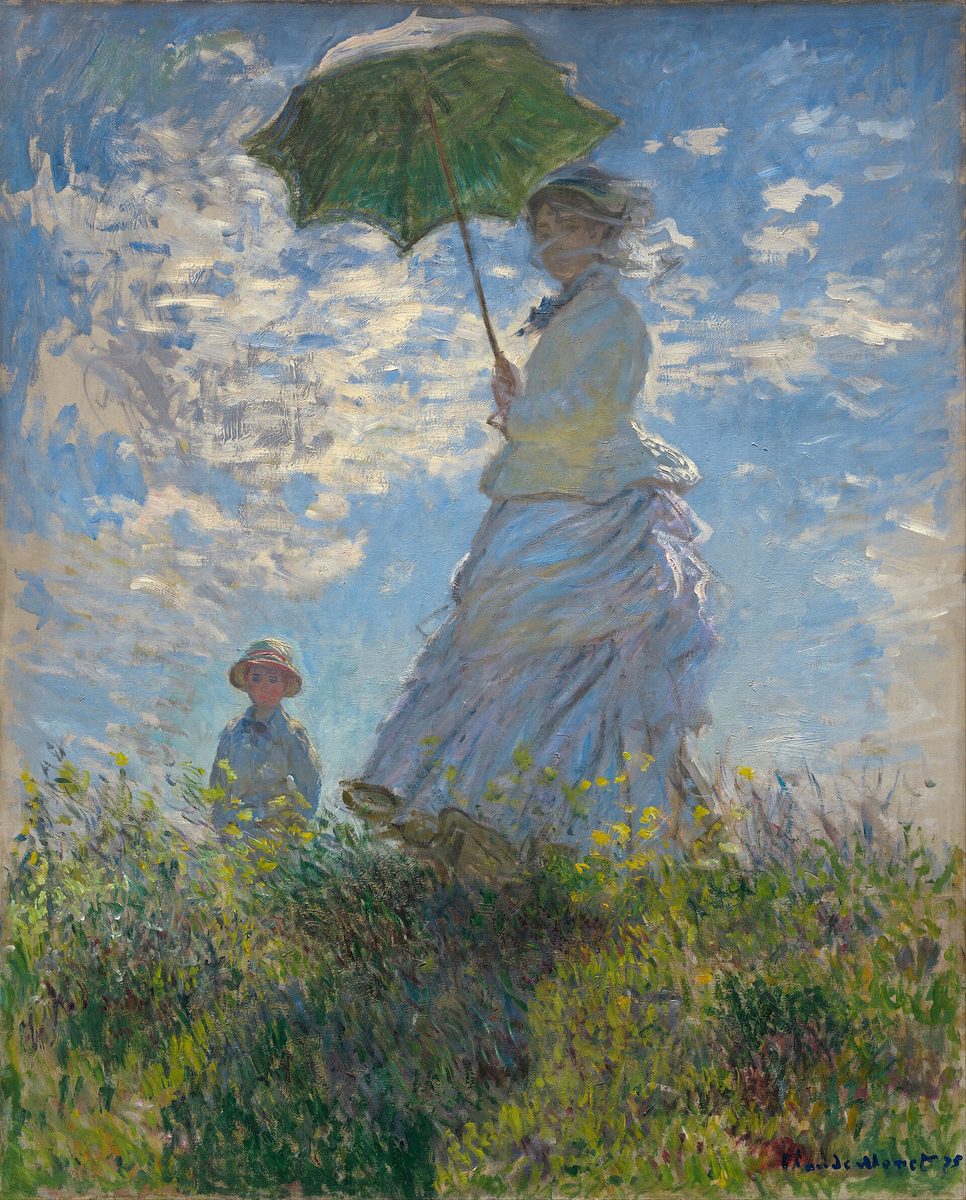
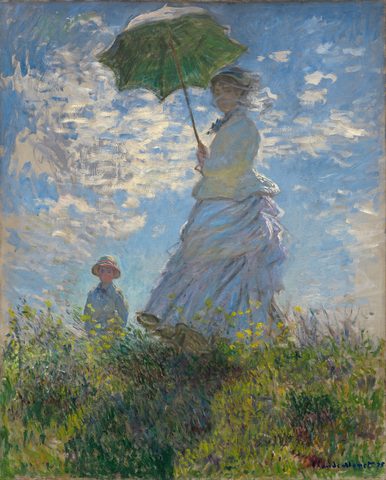
Woman with a Parasol, Madame Monet and Her Son by Claude Monet is an oil on canvas from 1875. It shows his wife Camille and their son Jean on a windy hillside, with the boy standing behind her in the grass. The canvas is worked with rapid, visible brushstrokes. It is signed and dated 'Claude Monet 75' at the lower right and measures 100 by 82 centimeters. It hangs in the National Gallery of Art in Washington, D.C.
What the picture shows
A woman stands on a grassy slope, seen from below against the sky. She holds a green parasol over her head. She wears a white dress and a hat with a veil that blows in the wind, partly covering her face. Her skirt and veil sway to the left, suggesting wind. A small child in a hat stands farther back on the left, partly hidden by the grass, at about half the woman's height. The sky fills most of the picture: blue with white, quickly brushed clouds. The grass in the foreground is green and yellow, with small yellow flowers. Her shadow falls on the grass in front of her; light comes from behind her. Rapid, visible brushwork defines the whole surface. The palette is sky blue, white, green and yellow, with blue-violet shadows on the dress.
When and why it was painted
Claude Monet was in his mid-thirties in 1875 and living at Argenteuil, a town on the Seine northwest of Paris. He painted outdoors, directly in front of the motif, to record changing light and weather. The first Impressionist exhibition had taken place the year before, and Monet was at the center of that group. This work combines a family subject with Impressionism's main concern: how light and wind alter what the eye sees in a single moment. Camille Monet and their son Jean appear on a grassy slope, but the painting is not a formal portrait. It is a study of movement, with the veil, skirt and clouds all caught mid-motion. Monet's quick, visible brushwork turns an ordinary family walk into a record of a windy day.
Seeing it at home
A hand-painted copy works best at or near the original size, 100 by 82 centimeters, so the vertical sweep of the sky stays intact. The surface should show visible brushwork, not flat, even blending. The copyist should keep the palette limited: sky blue, white, green, yellow, and blue-violet in the shadows of the dress. The veil and skirt need to feel windblown, not stiff.