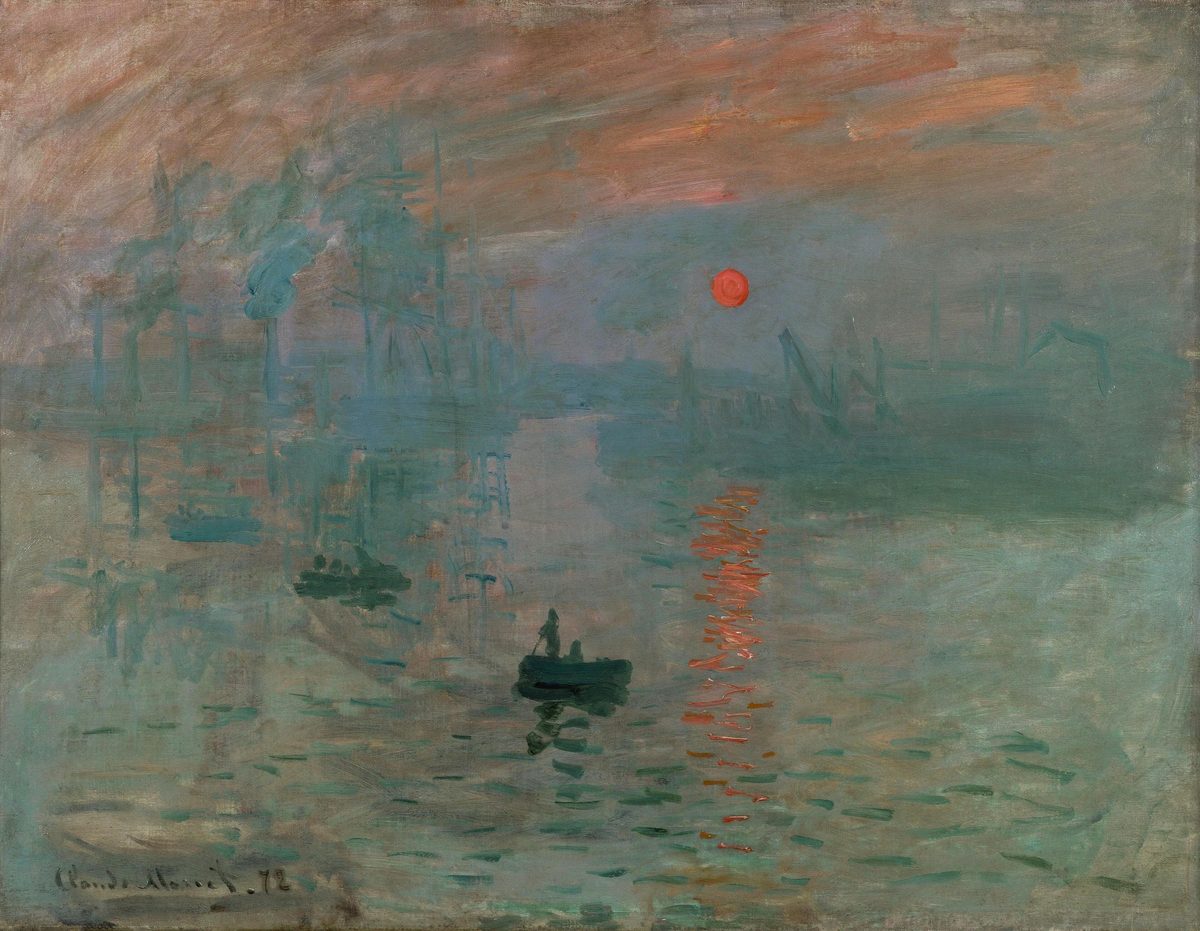
Impression, Sunrise by Claude Monet is an oil on canvas from 1872. It measures 48.0 by 63.0 cm and hangs in the Musée Marmottan Monet in Paris. The horizontal canvas is roughly 4:3. The picture shows a harbour at dawn, with loose brushwork and a low orange sun. Monet signed and dated the canvas 'Claude Monet 72' at the lower left. It was first shown in Paris in 1874, and the title became the source of the term Impressionism.
What the picture shows
The scene is a harbour seen across water at dawn, wrapped in blue-grey mist. In the foreground centre a small dark rowing boat holds a standing figure, apparently rowing or sculling. Two more small boats sit to its left, fading into the haze. Just right of centre, above the horizon, a small, bright orange sun hangs in a sky streaked with pink-orange and grey-blue. Its reflection falls on the water below as a vertical band of short orange-red strokes. In the background, faint silhouettes of masts, cranes, chimneys with smoke, and ships emerge through the mist. The dark rowing boat is the most defined shape; other forms lose their edges in the blue-grey atmosphere. The surface is built with loose, quick brushstrokes, and the water is suggested by short horizontal dashes. Claude Monet's signature and date 'Claude Monet 72' appear at the lower left.
When and why Impression, Sunrise by Claude Monet was painted
In 1872, Claude Monet was in his early thirties and had begun working outdoors with quick, broken strokes to record changing light and weather. Harbours and water gave him subjects where reflections and mist softened every edge. Impression, Sunrise records a single moment at dawn. When it appeared in Paris in 1874 at the first exhibition of the group later called the Impressionists, the title caught a critic's attention and gave the movement its name. Many viewers at the time found the loose handling and blue-grey palette unfinished because the masts, cranes, and boats are built from a few short strokes. The small size, 48.0 by 63.0 cm, adds to the sense of a quick observation made on the spot.
Seeing it at home
A hand-painted copy should stay close to the original's modest size, 48.0 by 63.0 cm, because the broad composition depends on a single glance. Look for loose, open brushwork with no heavy impasto, and for the orange sun and its reflection kept as short separate strokes. The palette should remain mostly blue-grey with pink-orange in the sky, without becoming too brightly saturated.