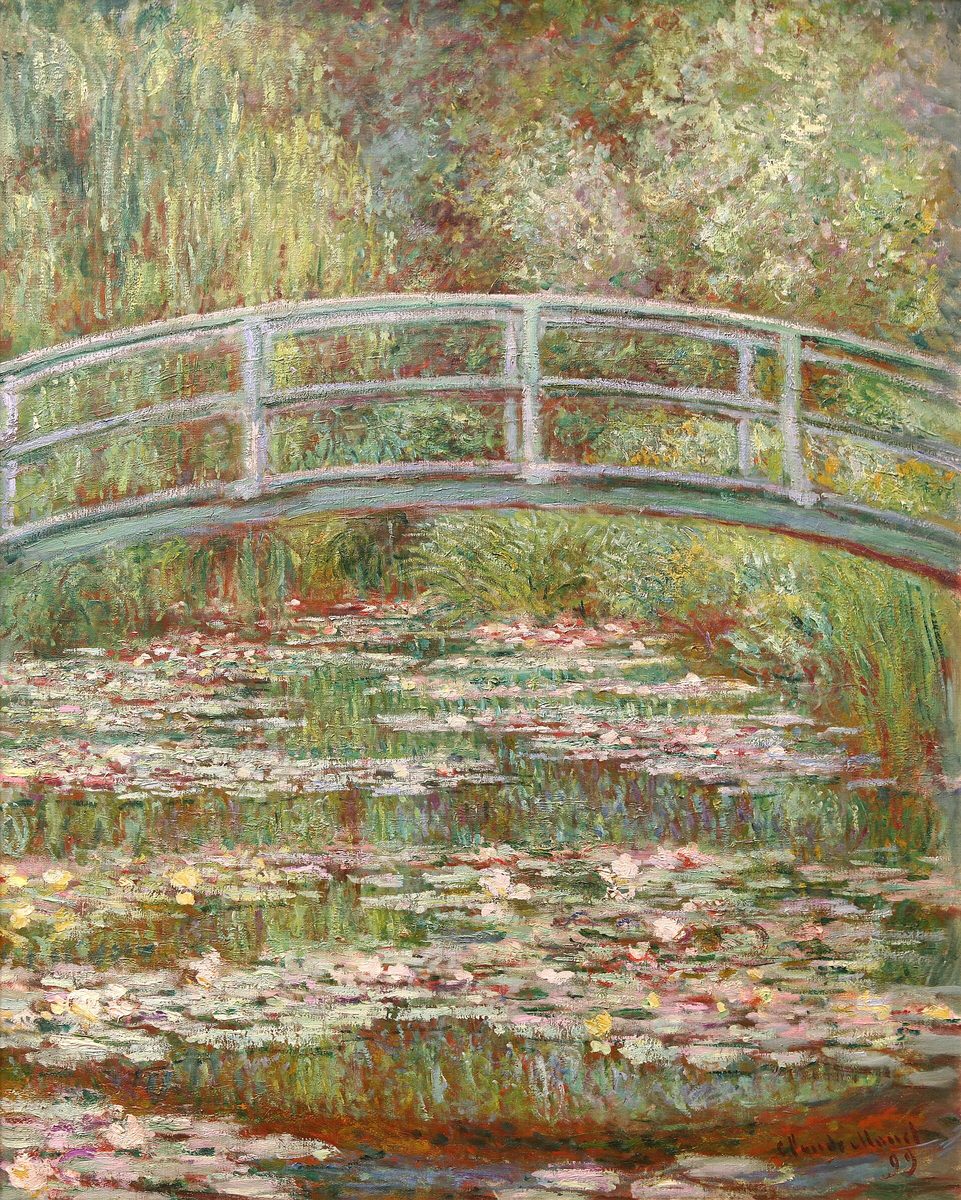
Claude Monet painted Bridge over a Pond of Water Lilies in 1899. The oil on canvas, 92.7 by 73.7 centimeters, hangs in the Metropolitan Museum of Art in New York City. The vertical picture looks across the water-lily pond at Giverny, where Monet had laid out a water garden in the 1890s. It belongs to a group of views of the bridge and pond that Monet painted in 1899. The work is signed and dated 'Claude Monet 99' at the lower right.
What the picture shows
The picture reads from the bridge first. It is a pale green arched wooden footbridge that spans the canvas edge to edge in the upper half. Its railing is simple: horizontal rails and upright posts. Below it a pond is covered with floating water-lily pads in green, with white, pink and yellow flowers. Between the pads, the water reflects the green of the trees and the bridge. Behind the bridge, dense foliage of trees and weeping willows fills the top of the picture, with no sky visible. Reeds and grasses grow along the banks on the right and under the bridge. The palette is made of greens, yellow-greens, pink, white, and touches of red-brown. Thick, short brushstrokes carry the image; the lily pads are laid as horizontal dabs. The signature 'Claude Monet 99' sits at the lower right.
When and why it was painted
By 1899 Monet was fifty-eight years old and living at Giverny in Normandy, where he had laid out the water garden that supplied this subject. He painted the bridge directly from the garden. This canvas belongs to an early series of water-lily works, in which he focused on the arched bridge and the surface of the pond. The broken brushwork, the reflected greens, and the absence of visible sky tie the painting to Impressionism. Monet worked outdoors and recorded what changed in the light and in the water, an approach he kept in his later garden pictures.
Seeing it at home
A hand-painted copy of this picture works best at a size close to the original 92.7 by 73.7 centimeters, so the bridge keeps its span across the upper half. Ask for the same palette of greens, yellow-greens, pink, white, and red-brown. The painter should use short, thick strokes and lay the lily pads as horizontal dabs, with no sky visible behind the trees.