Religious Paintings
Religious paintings show figures and stories from Jewish and Christian scripture, saints' lives, or devotional images such as the Virgin Mary, Christ, or the Crucifixion. The category also includes subjects like the Annunciation, the Nativity, and the Last Supper when they appear as the main story in a picture. Many famous religious paintings began as altarpieces or private devotional panels, on wood, canvas, or plaster. Across our catalogue, the term covers any painted image in which a sacred figure or narrative is the central subject.
A short history of religious paintings
During the Renaissance, painters in Italy and northern Europe used oil on panel and fresco to make biblical figures more natural and three-dimensional. Linear perspective, anatomical study, and landscape backgrounds gave scenes from the life of Christ a familiar, physical setting. Altarpieces for church high altars and small panels for private prayer were common, made for monasteries, confraternities, and wealthy families. In the 16th century, the Protestant Reformation reduced church patronage for religious images in parts of northern Europe, while the Catholic Counter-Reformation encouraged clear, emotionally direct pictures that could teach the faith. Baroque painters such as Caravaggio and Rubens pushed this direction with strong contrasts of light and dark and crowded, muscular compositions. Rembrandt later brought a quieter, more introspective tone to biblical subjects, often using browns and deep shadows. By the 19th century, religious painting continued in academic salons, though it shared attention with history painting and genre scenes. Early 20th-century painters still returned to biblical themes, sometimes simplifying forms or using modern color to update older iconography.
Painters in this catalogue
Several painters in this catalogue made religious subjects a central part of their work.
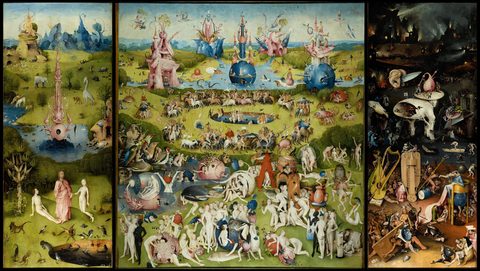
- Hieronymus Bosch (Netherlandish, 1450-1516) filled biblical scenes with hybrid creatures and moral warnings.
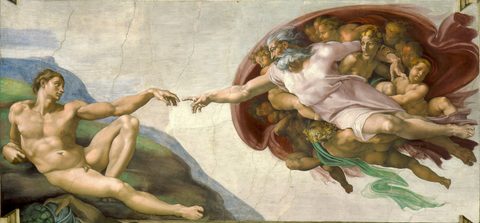
- Michelangelo (Italian, 1475-1564) painted muscular biblical figures in large fresco cycles.
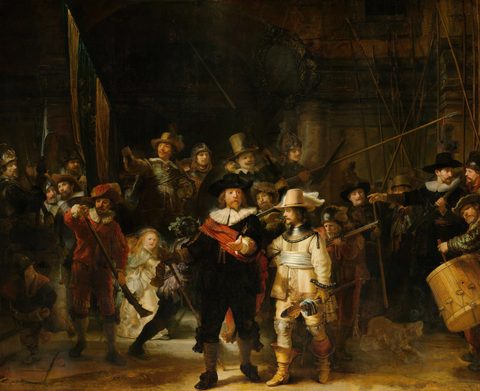
- Rembrandt (Dutch, 1606-1669) returned often to biblical stories, using dark browns and a single light source.
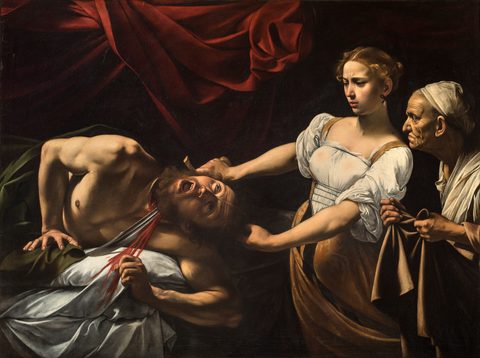
- Caravaggio (Italian, 1571-1610) placed sacred figures in shallow, dramatic light, making them look like ordinary people.
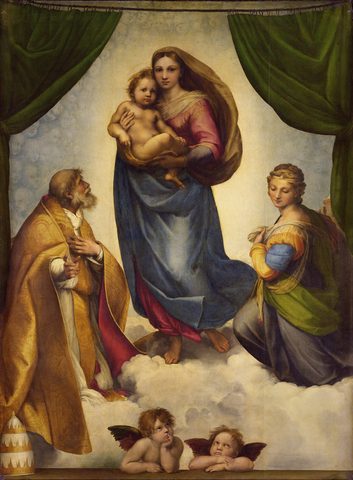
- Raphael (Italian, 1483-1520) painted calm Madonnas and balanced groupings of holy figures.
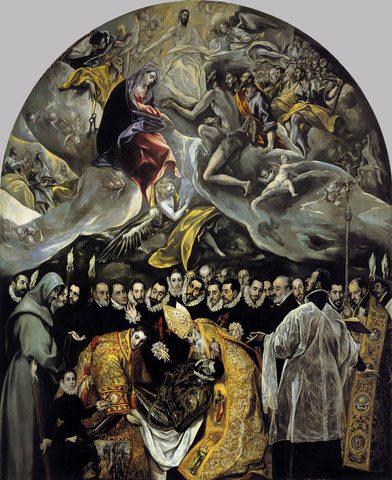
- El Greco (Greek and Spanish, 1541-1614) elongated bodies and used cold, eerie color for visions and saints.
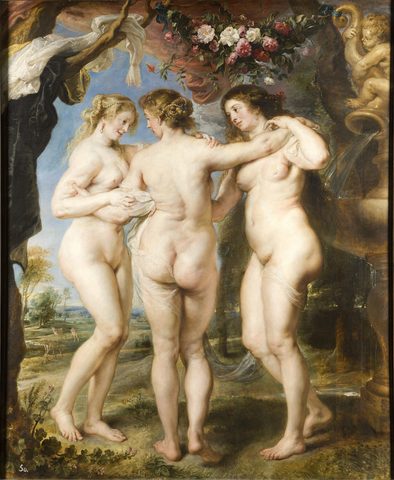
- Peter Paul Rubens (Flemish, 1577-1640) filled altarpieces with twisting, energetic figures and strong color.
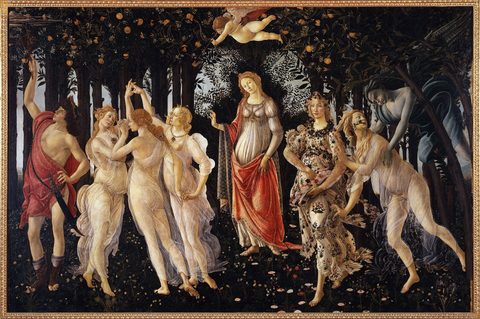
- Sandro Botticelli (Italian, 1445-1510) gave biblical scenes a delicate, linear grace and pale light.
What to look at
Look first at how the figures are arranged, often a triangle or a diagonal line pulls your eye toward the main sacred figure. Notice where the light falls; a bright area often marks the holy figure or moment of revelation. Check the surface for brushwork, cracks, or gilding.